A developer ships a feature in an afternoon with Claude Code, opens a pull request, and writes "AI-powered" in the description. Their manager nods. The release goes out. A week later, a different developer is paged mid-deploy trying to figure out why an agent silently leaked a customer's tickets into another tenant's retrieval index, and the retro discovers there was never an eval set, never a permission boundary, and never a way to roll back the prompt.
Both developers used AI. Only one of them was building an AI system.
That distinction is becoming the most important one in our craft right now, and most of the discourse is still blurring it.
The new baseline: AI-assisted coding
Let me be clear about something first. AI-assisted coding is not a fad and it is not "cheating." It is the new baseline.
A developer who uses Claude Code, Cursor, Copilot, prompt templates, and workflow automation to generate, refactor, debug, and ship code is doing real engineering work. They are:
- Increasing their personal throughput in a way that was unimaginable five years ago.
- Lowering the cost of exploring unfamiliar APIs, languages, and frameworks.
- Iterating faster on UI, data shapes, and small refactors.
- Being forced to get better at decomposition, context management, and clear communication — because that is what makes the tools useful.
Anyone in a leadership role who dismisses this is going to be out-shipped by the team that embraced it. I am not interested in gatekeeping productivity.
But there is a limit to what this kind of work tells you about a developer's depth. An AI-assisted developer can be excellent at operating the tools and still not know how a model behaves under adversarial input, how a data pipeline ingests and chunks documents, how retrieval ranking shifts when a tenant goes from a thousand records to a million, how evaluation suites catch silent regressions, how cost and latency compound across a multi-step agent, or how a model fails when it is confidently wrong.
None of that is the developer's fault. It is just that producing code is a different skill from designing a system that has a model inside it.
The other skill: AI systems engineering
The AI systems builder is doing something categorically different. They are not "using AI" — they are building the surface that other people will trust to use AI safely.
That means:
- Engineering everything that surrounds the model, not just calling it. The model is one component. The system is the data sources, the retrieval layer, the tools the model is allowed to call, the human approval points, the fallback paths, the observability, and the way state is carried between turns.
- Treating data quality as a first-class concern: ingestion, deduplication, chunking strategy, embedding choice, hybrid lexical + vector search, reranking, metadata, freshness, and the access control that decides which chunks any given user is even allowed to see.
- Building evaluation loops for accuracy, hallucination rate, refusal behavior, regression catch, and task success — and separating the blocking set from the monitoring set from the backlog. (We have written about this at length.)
- Operating the system: latency budgets, cost ceilings, tracing across model calls and tool calls, prompt and model version control, drift detection, and a rollback that works.
- Designing guardrails: permission scopes, tool whitelists, human-in-the-loop checkpoints for irreversible actions, safe failure modes when the model is uncertain.
- Knowing when the model is wrong, overconfident, incomplete, insecure, or being asked to do something it should not be doing in the first place.
The list reads long because the surface is long. None of it is exotic and none of it requires a PhD. It does require treating the model as an unreliable but powerful component that has to be engineered around, not a magic function that returns answers.
Two scenes
Scene one. A developer asks Claude Code to generate a feature that summarizes a customer's recent support tickets. Claude produces the route, the React component, and the prompt. The developer reviews the diff, runs it locally, ships it. Total time: an afternoon. This is good work.
Scene two. A different developer is designing an AI-powered code analysis platform that ingests a company's monorepo, embeds it, and lets engineers ask questions about it. They are thinking about: how to chunk code without breaking semantic boundaries, whether to embed at the function level or the file level, how to filter retrieval by which repos the asking user has read access to, how to evaluate "did the answer cite the right file," how to catch silent regressions when they swap an embedding model, what happens when the index is stale, how to budget cost per query, and how to expose tracing when someone says "the answer was wrong." Total time: weeks, with a real team. This is also good work — but it is a different kind of work entirely.
Or, more starkly: a developer prompting an agent to write a piece of marketing copy is doing AI-assisted work. A developer building an agentic platform that runs continuous campaign optimization — proposing variants, running tests, gating launches on conversion lift, watching for prompt injection from user-generated input, and keeping a human in the loop on spend — is building an AI system.
Or, the one I see most often: a developer who says "we use RAG" because they wired up an embedding call and a vector store, versus a developer designing secure retrieval with proper chunking, hybrid search, metadata filters, tenant-scoped access control, reranking, and an eval set that proves the system answers correctly under load. The first one demos. The second one survives production.
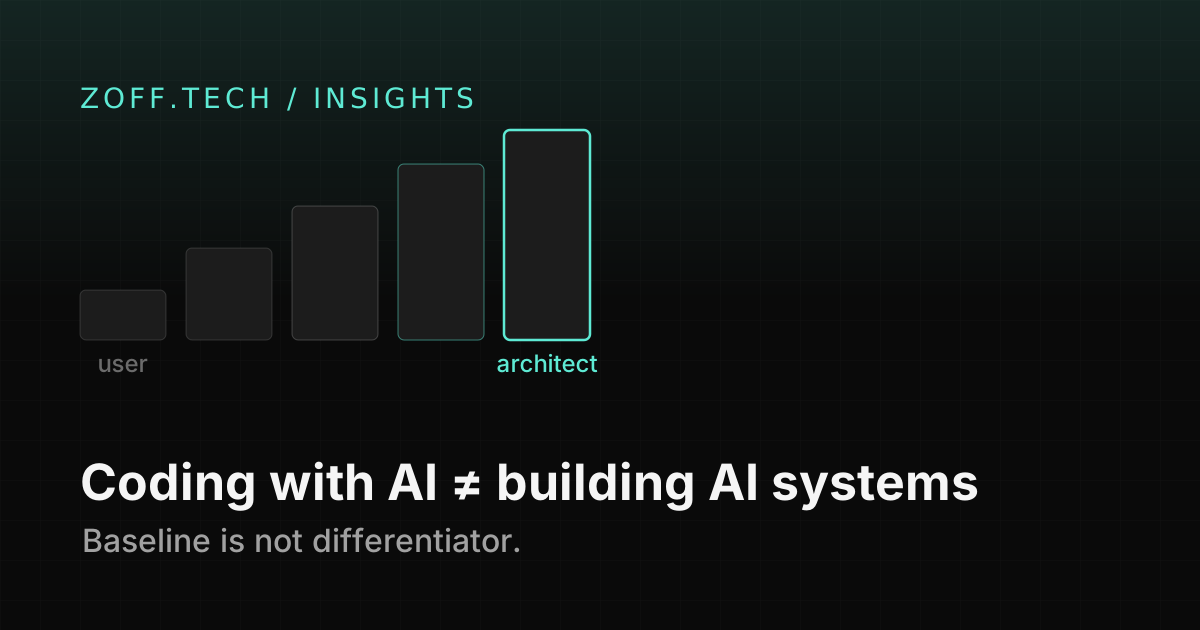
A maturity curve
It is more useful to think of this as a curve than a binary. Roughly:
- AI tool user. Uses ChatGPT or Claude in a browser to unblock themselves.
- Prompt and workflow power user. Has personal prompt libraries, uses coding agents inside their editor, automates parts of their daily work.
- AI feature builder. Adds a model-powered feature to an existing product. Calls an API, writes a prompt, ships it behind a flag.
- AI systems engineer. Designs the full system around the model: retrieval, eval, observability, guardrails, cost, fallback. Knows the failure modes and has tested them.
- AI product or platform architect. Designs the platform on which other teams safely build features. Owns the conventions, the evals, the safety boundary, the cost model, and the path from prototype to production for the whole organization.
Most developers today live somewhere between 1 and 3. The shortage — and the real differentiator — is at 4 and 5. Not because those levels are gatekept, but because they take a different kind of engineering judgment that prompt fluency does not, by itself, produce.
The car analogy
Using AI to code is like learning to drive a high-performance car. It is a real skill, it dramatically expands what you can do, and the people who refuse to learn it are going to fall behind.
Building AI systems is understanding the engine, the sensors, the road conditions, the safety systems, the maintenance schedule, and the failure modes. It is what lets you decide when the car is safe to put on a public road, when the brakes are about to go, what to do when the road is icy, and how to design a vehicle for someone else to drive.
Both matter. They are not the same skill. And one of them is what you want from the person who certifies the car for production.
What this means for hiring, teams, and leverage
The trap I keep seeing is teams that confuse the two. They hire for prompt fluency and then put that person in charge of a production agent. They reward the developer who shipped six AI features in a quarter without asking what happens when those features get traffic. They put "AI engineer" on the job posting and then are surprised when the person they hired cannot debug a retrieval regression or design an eval suite.
The fix is not to devalue prompt-fluent developers. It is to be honest about which work is which, and to grow people deliberately up the curve. The strongest engineers I have worked with this year are the ones who combine AI-assisted speed at the leaf nodes of their work — generating code, exploring APIs, sketching components — with deep engineering judgment about the system around them. They ship faster and their systems hold up.
That is the combination. Not "AI users" versus "real engineers." AI-assisted execution paired with systems thinking.
Prompt-based development is real, valuable, and the new baseline — a developer who refuses to learn it is choosing to be slower than the market. But baseline is not differentiator. The future belongs to the developers who understand enough to build systems where AI can be trusted, not just to the ones who can code with it.