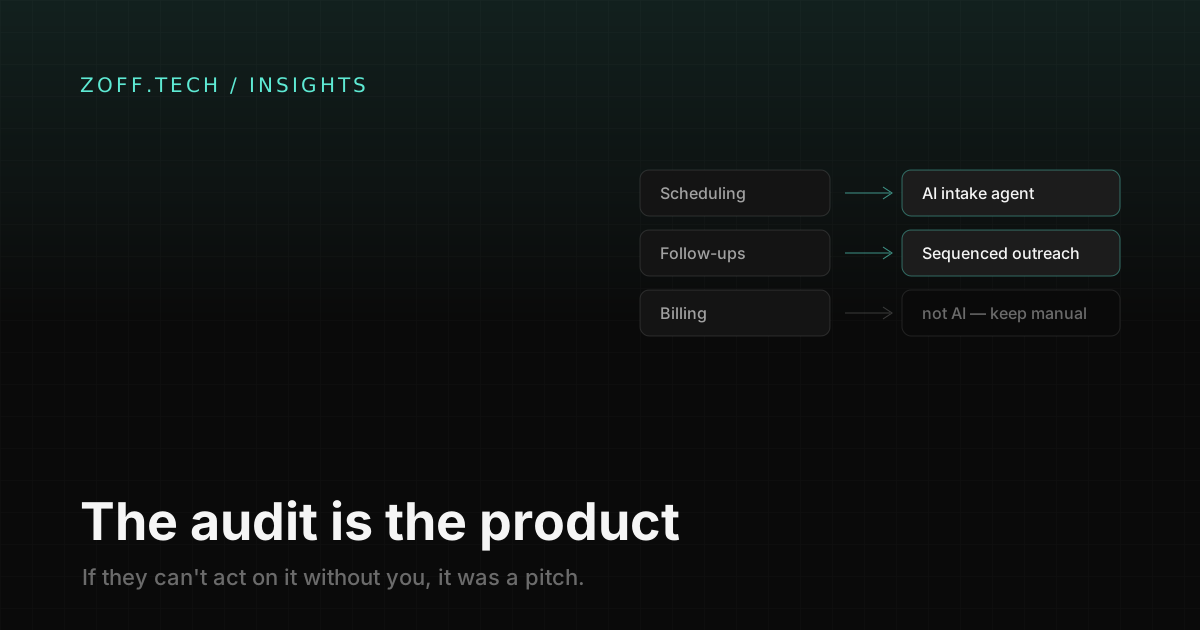
A company pays for an "AI strategy assessment." Four weeks later they get a slide deck. The deck says they should "leverage AI to drive efficiency," lists six trends, and recommends a "phased adoption roadmap." Nobody in the room can do anything with it on Monday. The engagement quietly ends. The company concludes AI is overhyped. They are half right — the hype was in the deck, not in the technology.
The failure was upstream of the build. It was in the audit.
What most AI audits actually are
Most AI audits are a sales motion wearing a consulting costume. The goal is to sound credible long enough to land the implementation contract. So the deliverable optimizes for impressiveness, not for action: market context, competitor name-drops, a maturity model with the client helpfully placed one notch below where they need to be.
The tell is that you could hand the same deck to a different company in the same industry and change three logos. Nothing in it is load-bearing. It does not commit to anything, so it cannot be wrong, so it is also useless.
What an audit is for
An audit exists to answer one question with enough specificity that someone can act on it: where, concretely, will a model save this organization time or money, and what is it worth?
That means walking the actual operation. Not "marketing" as a category, but the specific path a lead takes from the contact form to a booked call, and the four manual handoffs in the middle where a person retypes the same information. Not "support," but the 200 tickets a week that are the same five questions, and the eleven-minute average response time that loses deals after hours.
You map every core function — intake, scheduling, billing, follow-up, reporting — and against each one you write a specific intervention, a rough cost, and a rough value. Some of those interventions are not AI at all. The honest audit says so, because the credibility of the whole document depends on it not being a pitch.
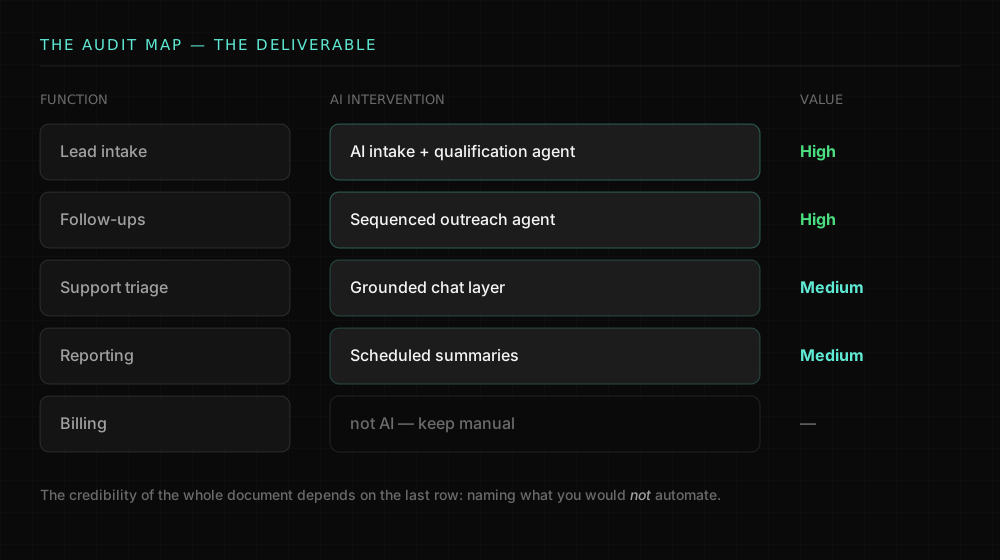
The deliverable stands alone
Here is the discipline that separates an audit from a sales call: the audit has to be worth the money even if the client never hires you to build anything.
If they take your document, hand it to their own team, and execute it without you, you delivered exactly what you sold. That constraint forces the document to be real. It has to contain enough specificity — which process, which tool, which integration, roughly what it costs, roughly what it returns — that a competent team could act on it. A sales deck cannot survive that constraint. A real audit is built for it.
This is also why the audit is the better business. A one-off lead-gen handoff is transactional: deliver, get paid, done. An audit that genuinely maps an organization's operation opens a relationship that expands — implement the first three, then the next three, then operate them. The expansion is earned by being right the first time, in writing, where it could have been checked.
Why the competition is thinner than it looks
The market is loud with people who call themselves AI consultants. It is quiet on people who can sit across from an operator, look at a real workflow, and say with specificity: these three processes, in this order, here is how, here is what it is worth, and here is the one I would not automate yet.
That sentence requires two things that rarely travel together. It requires enough technical depth to know what is actually buildable — what retrieval can and cannot do, where an agent needs a human checkpoint, what a wrong answer costs in this domain. And it requires enough operational understanding of the specific industry to know which inefficiency actually hurts. Most "AI consultants" have neither. They have prompt fluency and a deck template.
The niche is the unlock. "AI for dental practices" beats "AI consulting" by a wide margin — easier to find clients, easier to build the audit framework once and reuse it, easier to be specific because you already know the operation. The framework — every core function in a typical practice, mapped to a specific intervention — is an afternoon of work and becomes the deliverable you sell for the rest of the year.
What this means for how we work
We treat the assessment as the first engineering artifact, not the pre-sales formality. It carries the same standard as everything downstream: specific, checkable, and honest about what is not worth doing. If we cannot point to a concrete process and put a number next to it, we do not write a sentence claiming we can.
The build is where the value gets realized. The audit is where it gets decided. A vague audit guarantees a build that drifts, because there was never a target it was measured against. A specific one makes the build almost boring, in the good way — you already know what you are building, why, and what it is worth.
The deck that says "leverage AI to drive efficiency" is a way of getting paid without committing to anything. Hold the work to a higher bar: if the client could not act on it without you in the room, you wrote a pitch with a cover page, not an audit. The audit is the product only when it stands on its own.