A founder is drowning. Email, calendar, follow-ups, the phone, the dozen small operational tasks that fill a day and never end. Someone offers them a chatbot — a smart text box they can ask things. It helps, a little, the way a good search box helps. They still do all the work; they just ask better questions while doing it.
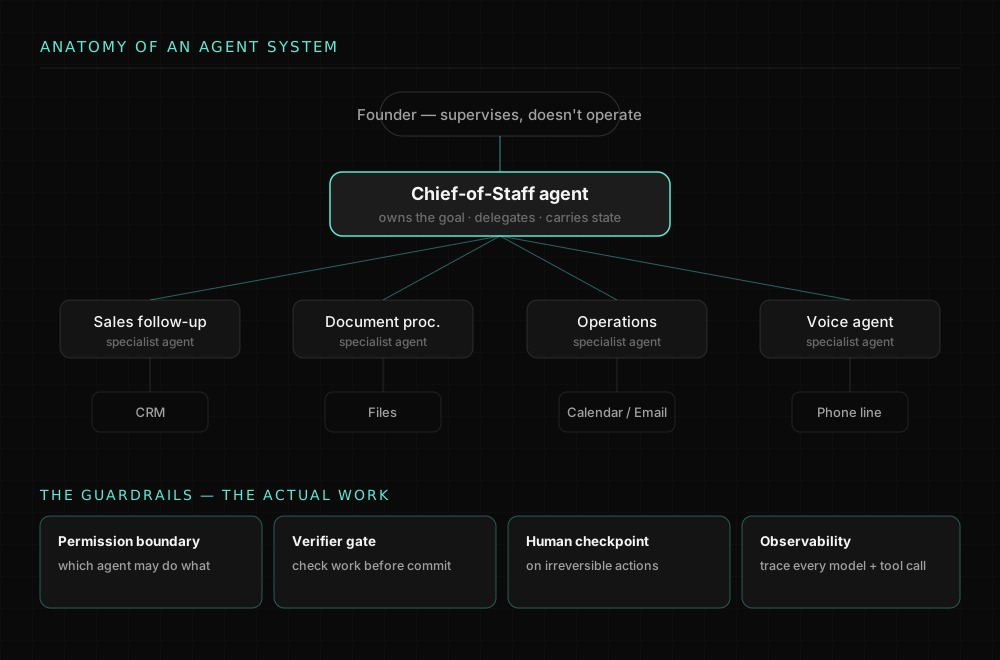
Now offer the same founder something else: not a text box, but a chief-of-staff agent that runs the email, drafts and sends the follow-ups, manages the calendar, and hands the phone calls to a voice agent that books appointments — and that agent, in turn, manages a handful of specialist agents underneath it, each owning a workflow. Sales follow-up. Document processing. Operational chores. Client check-ins.
That is not a smarter text box. That is a team. And the difference between those two things is the entire opportunity.
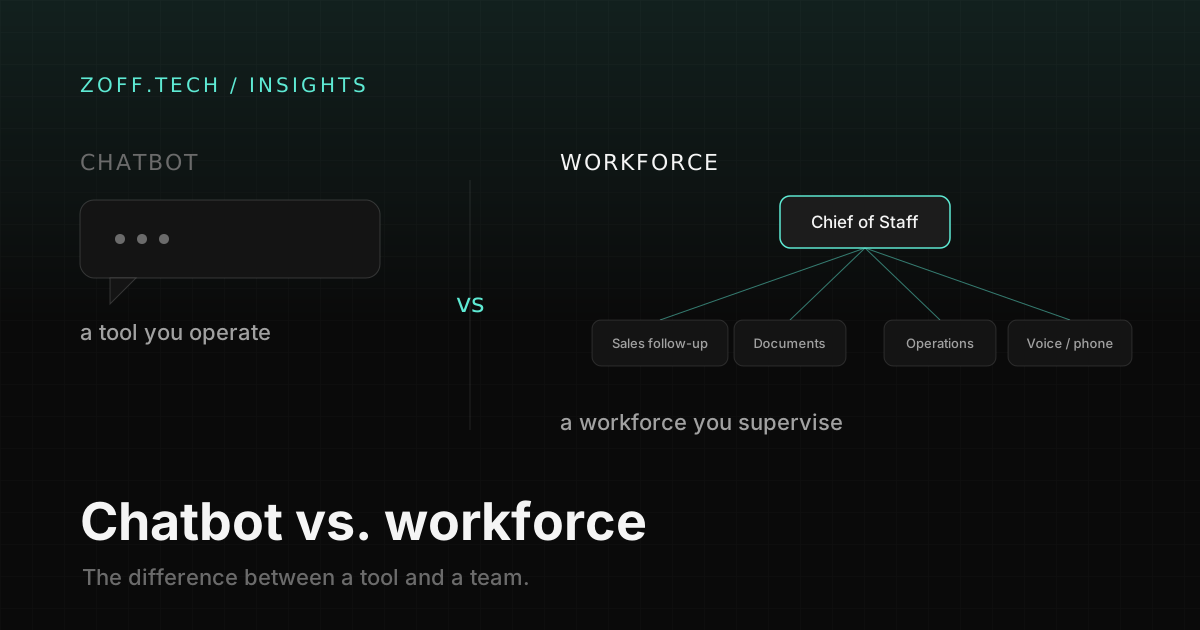
A chatbot is a tool. An agent system is a workforce.
A chatbot waits for you. You ask, it answers, you act. The work still routes through you; the bot is a faster reference. Useful, bounded, and fundamentally a tool you operate.
An agent system does the work. It has a job, it takes actions in the real systems — the inbox, the calendar, the CRM, the phone — and it carries state across steps without a human holding the thread. The structure that makes this work is hierarchy: an orchestrator at the top that owns the goal and delegates, and specialist sub-agents underneath, each scoped to a workflow it is good at. A chief-of-staff agent that manages a sales-follow-up agent that manages the CRM is structurally a small org, not a chat window.
This is why the economics are categorically different. A chatbot makes a person a bit faster. An agent system attacks the largest line on a small business's expense sheet: labor. When a $2,000-a-month agent system does the work of a $60,000-a-year role — around the clock, no sick days, no turnover, no quitting — the owner is not buying software. They are buying a number on a spreadsheet that they can see. You are not selling a tool. You are selling savings.
Why this is the hardest and most durable version of the work
Everything that makes an agent system valuable is also what makes it hard, and the difficulty is the moat. A text box that calls a model is an afternoon. An agent system that takes real actions, reliably, without supervision, is the deep end of this craft — and it is exactly the surface we spend our time on.
The reasons it is hard are the reasons it is defensible:
- It takes irreversible actions. A chatbot suggests; an agent sends the email, books the slot, moves the money. Every action that cannot be undone needs a boundary and a human checkpoint, and getting that boundary right — tight enough to be safe, loose enough to be useful — is judgment, not configuration.
- Permissions are the architecture. An agent managing your inbox can read everything in it. A sub-agent touching the CRM can change customer records. Which agent is allowed to do what is not a setting you add at the end; it is the shape of the system.
- It has to know when it is wrong. A multi-step agent that confidently does the wrong thing, four steps deep, does damage a chatbot never could. Verifier-gated loops — checking the work before it commits — are what separate an agent that acts from an agent that flails expensively.
- Cost and latency compound. Every step is model calls and tool calls, and they stack. A system that is fine in a demo can be slow and ruinous at scale unless someone budgeted it. The discipline of the cheapest model that passes the eval matters far more in a ten-step agent than in a single chat reply.
- You have to be able to see inside it. When an agent system does something wrong, "the AI messed up" is not a debuggable statement. Tracing across every model and tool call — what it decided, why, with what inputs — is the difference between an incident you can fix and one you can only apologize for.
A chatbot needs almost none of this, which is why almost anyone can ship one, which is why it competes on price. An agent system needs all of it, which is why the competition is genuinely thin and the work holds its value. The barrier is real engineering judgment, and that does not commoditize on the next model release — it compounds.
Start with one agent, not the org chart
The durable version of this is built one agent at a time. Do not start by selling the full autonomous workforce; start with one painful, legible workflow. A chief-of-staff agent is the easiest first sell because every overwhelmed founder already knows what it is worth — give me back ten hours a week of email and calendar and follow-up and I will pay for it today.
Prove that one agent, with its boundary and its checkpoint and its trace, and the system grows by adding specialists underneath it. That is also how you build it safely: each agent earns its scope before the next one is added, rather than launching an org chart of unsupervised agents and discovering the permission model in production.
A chatbot is a tool you operate. An agent system is a workforce you supervise. One makes a person faster; the other does the job.
That is why this is the strongest opportunity in AI right now for anyone with the engineering depth to build it — and why it stays strong. The value was never the model; it is the system around it: the boundaries, the verifiers, the permissions, the observability, the judgment about what an agent is allowed to do when no one is watching. Build that, and you are building the work that lasts.