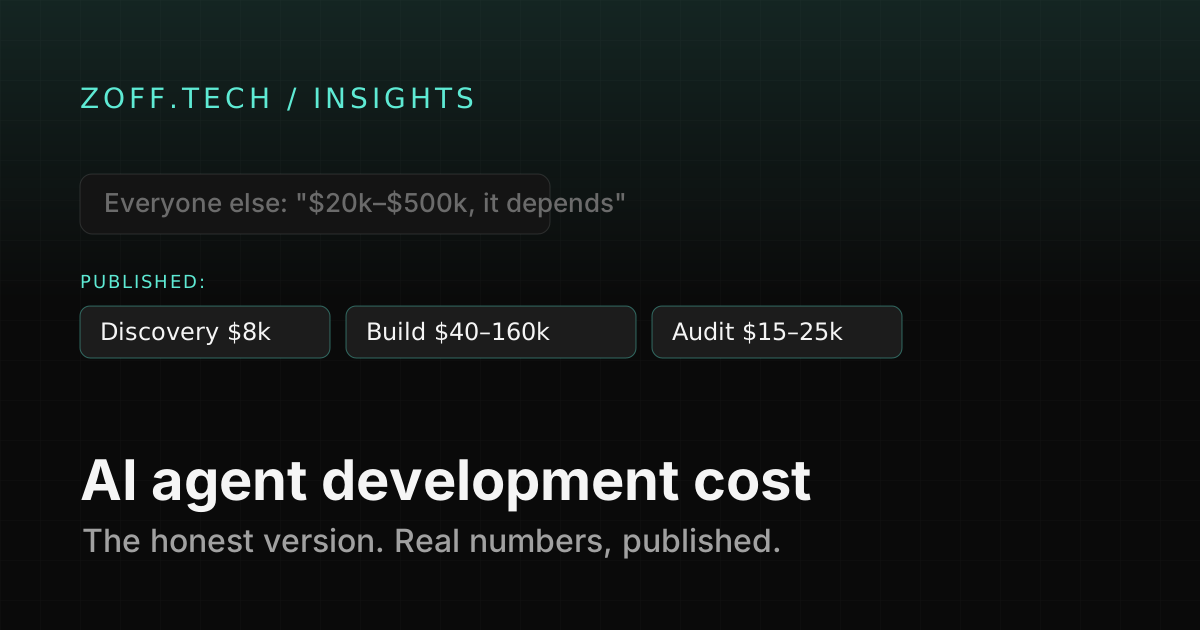
Search "AI agent development cost" and you get a dozen guides that quote ranges — "$20k to $500k, it depends" — and then never tell you what they charge. The range is technically true and practically useless. It is the pricing equivalent of "it depends," and it exists because most firms would rather you book a call before you see a number.
We publish our numbers. Here they are, what drives them, and the cost that none of those guides put in the headline: the part that shows up after launch.
What we charge
Fixed fee or time-and-materials, depending on how much the scope is still moving. We tell you which model we are proposing on the first call, and why.
- Discovery + evaluation — from $8k, 1–2 weeks. We write the eval and prove the problem is buildable before anyone commits to a build. (If we can't write a defensible eval, we say so and stop here — that's the cheapest money you'll spend.)
- Build, small — $40–80k, 6–8 weeks.
- Build, medium — $80–160k, 10–14 weeks.
- Audit / review of a system already in or near production — $15–25k, 3 weeks, fixed price.
If those ranges fit your budget, the first call is about engineering, not a sales pitch. If they don't, we'll tell you and point you to someone who fits.
What actually moves the number
The spread inside "build" is not arbitrary. The cost drivers, in roughly the order they matter:
- How irreversible the actions are. An agent that drafts text is cheap. An agent that sends the email, moves the money, books the slot needs permission boundaries, human checkpoints, and verification — and that engineering is most of the bill on a serious build.
- Integration surface. One clean API is cheap. Five legacy systems with their own auth, rate limits, and failure modes is where the weeks go.
- Data and retrieval. If the answer to a sample question can't be found in your corpus with a citation a human would accept, you don't have a build yet — you have a data project wearing an AI budget. That work is real and it's not free.
- Evaluation depth. A throwaway demo has no eval. A system you can operate has a harness that gates every change. The eval is not overhead; it's the thing that makes the rest cheap to maintain.
- Compliance and security. Regulated data, tenant isolation, audit trails — each adds scope.
The cost the other guides bury: total cost of ownership
Here's the number that wrecks budgets, and it's almost never in the headline range: the bill after launch.
- Usage costs climb. Production traffic is not demo traffic. Token spend on a multi-step agent compounds, and teams that didn't pick the cheapest model that passes the eval or design the loop to be cache-aware pay several times what they should — every month, forever.
- Maintenance is real. Prompts drift, models get deprecated, integrations change. Plan for ongoing upkeep, not a one-time build. Industry rule of thumb runs 15–25% of the build cost per year; the number is lower when the system was built with an eval and a runbook, because you can change things without breaking them.
- The silent failures. The most expensive line item is the one nobody budgeted: a multi-agent system that fails quietly in production because no one can trace what it did. An incident you can't debug costs more than the build.
This is why our discovery step exists, and why it's cheap: it's the stage where we put real numbers on all of this before you've spent the build budget.
Why we publish prices when no one else does
Opaque pricing wastes everyone's time. A buyer with a $50k budget and a firm that starts at $200k both spend three calls discovering they don't fit. Publishing the numbers means the only people who reach the first call already fit the arithmetic — so the call is engineering, not qualification theater.
It's the same instinct as everything else we do: say the uncomfortable number up front, name the cost that shows up later, and let you make the decision with the real figure instead of a salesperson's optimism.
"AI agent development cost" has a real answer, and "it depends" is a way of avoiding it. It depends on irreversibility, integration, data, and the eval — and the biggest number is the one after launch, not the build.
Ours are published above. If they fit, bring us the problem, the owner, the budget, and the date. If they don't, we'll tell you who does — that introduction is free.