A plumber misses a call. The caller has a burst pipe and water on the floor, so they do not leave a voicemail — they call the next plumber on the list, who picks up. That missed call was a job worth a few thousand dollars, lost in the time it took to go to voicemail. Multiply by every after-hours call, every call during a job when both hands are occupied, every lunch break. For a certain kind of business — plumbers, HVAC, law firms, dental clinics — the phone is the business, and every unanswered ring is revenue walking to a competitor.
This is why an AI voice agent is a genuinely strong product. The pitch writes itself: a receptionist that never sleeps, never gets sick, never quits, for less than the cost of the salary it replaces. The math is obvious to the owner the moment they see it.
And the demo is, honestly, an afternoon. Bland.ai or Vapi, a template, a booking scenario. Record it handling one clean call and you have something to show. The demo is not the hard part.
The system is the hard part.
What the demo hides
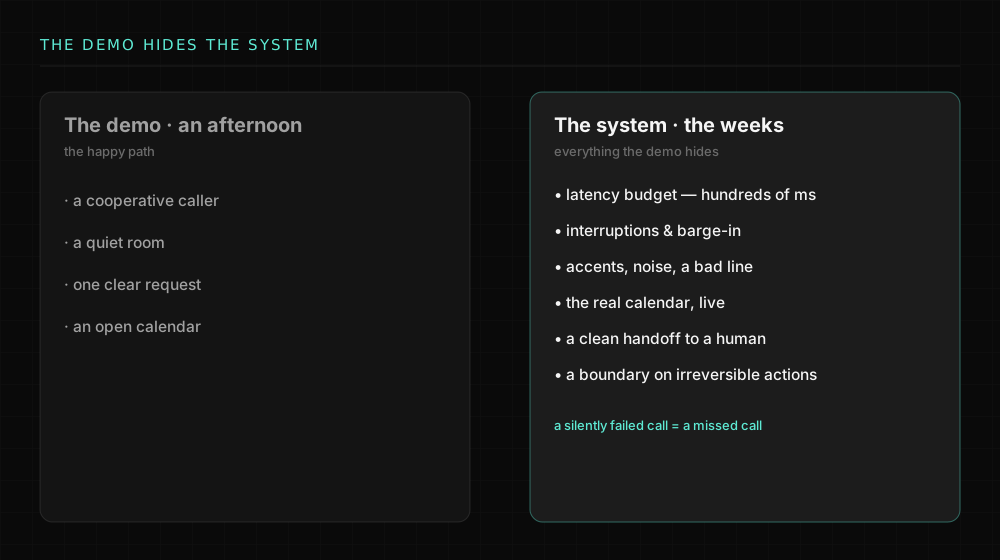
The demo runs on the happy path: a cooperative caller, a quiet room, one clear request, a calendar with open slots. Real inbound calls are nothing like that, and every gap between the two is where the job is actually done.
Latency is the product. On a screen, half a second of lag is invisible. On a phone, it is the difference between a conversation and a hostage situation. If the agent pauses too long before responding, the caller talks over it, the turn-taking breaks, and a human-sounding agent becomes obviously a robot. The entire pipeline — speech to text, the model, text to speech — has a latency budget measured in hundreds of milliseconds, and staying inside it under load is engineering, not configuration.
The interruptions. People interrupt. They change their mind mid-sentence. They give you the appointment time before you ask for the name, then the name with a spelling you have to confirm, then they cough and you lose a word. Handling barge-in and partial information gracefully is most of what makes a voice agent feel like a receptionist instead of a phone tree.
The accents, the noise, the bad line. The demo was recorded in a quiet room. The real caller is in a truck on a highway, on a marginal cell connection, with an accent the speech model handles worse than it handled yours. Transcription error is not an edge case here. It is the median case, and the system has to confirm critical details — the phone number, the address, the time — because getting them wrong does not produce a wrong answer, it produces a no-show.
Where the real engineering lives
Booking is the easy verb. The hard parts are the ones that touch the rest of the business.
The agent needs to actually read and write the real calendar, with the real availability, including the job that just got added by a human five minutes ago. It needs to know which requests it can handle and which it must hand to a person — and the handoff has to be clean, not a dropped call. It needs a defined behavior for the call it cannot complete: take a message, escalate, call back, but never silently fail, because a silently failed call is identical to a missed one from the customer's side.
And it needs the boundary every agent that takes real-world action needs. A voice agent that can book can also double-book, cancel, or quote a price it should not have quoted. The irreversible actions need a checkpoint or a constraint, the same as any agent we put near production. We have written about drawing that permission boundary and keeping a human on the irreversible actions — a voice agent is exactly that problem with a microphone attached.
Why it is still worth building
None of this is an argument against voice agents. It is an argument for taking them seriously. The opportunity is real precisely because the gap between the demo and the system is wide — anyone can record the demo, which is why the space is crowded in talk, but the businesses that need this cannot tell the difference until the agent is live and either holds up on the burst-pipe call after midnight or drops it.
Voice is also not a passing format. Talking is the oldest interface there is, and for a contractor with their hands full or a customer in a panic, it is the right one. The teams that learn to build voice agents that survive real calls are building on a surface that will matter for a long time. The ones shipping the afternoon demo are building a thing that books the demo call and loses the next one.
The voice agent is one of the strongest AI products on the table, and that is exactly why the demo is the easy part to mistake for the whole.
Everything that makes it actually replace a receptionist — the latency budget, the interruptions, the bad line, the real calendar, the clean handoff, the boundary on what it is allowed to do — takes the weeks the demo doesn't show. Sell the demo and you book one call. Build the system and you answer the phone.