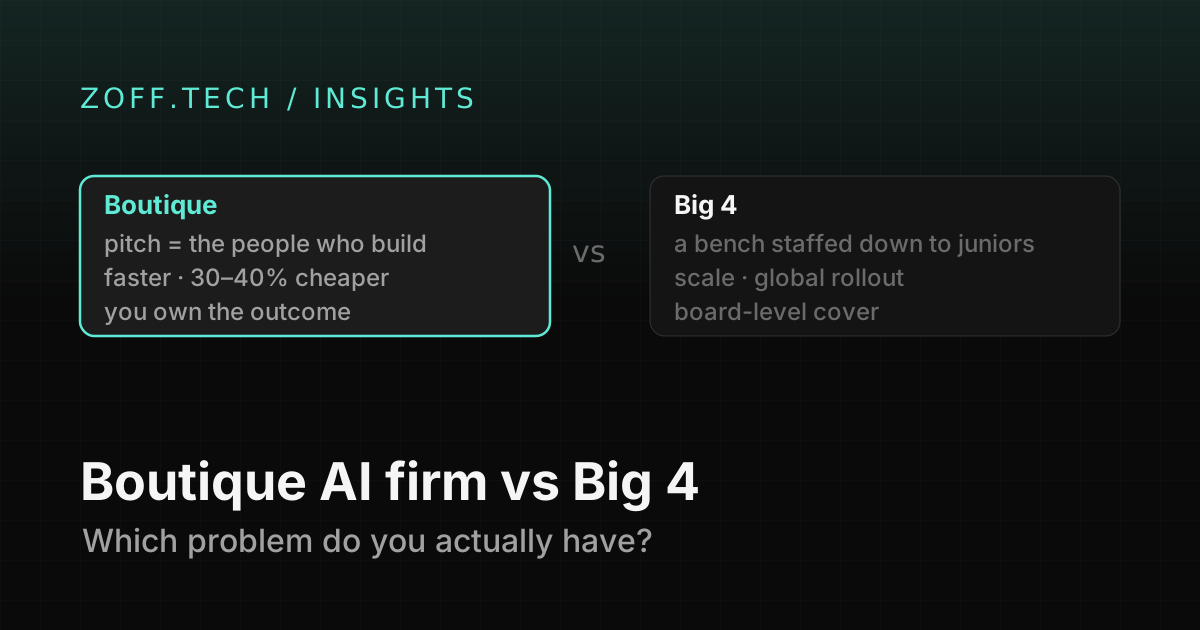
If you're putting an AI system into production, you'll eventually weigh a boutique AI engineering firm against a Big 4 (or big-systems-integrator) consultancy. Most comparison articles are written by one side to dunk on the other. Here is the honest version — including the cases where you should not hire a boutique like us.
The structural difference, stated plainly
A Big 4 firm has a bench: the partner who sells the engagement is not the person who writes the code. The work is staffed down to analysts and rotated as people move between projects. That's not a flaw — it's how you field a 25-person team across multiple jurisdictions. But it means the seniority that wins the pitch is rarely the seniority that ships the system.
A boutique is inverted: the people who pitch the engagement are the people who do the work. There is no bench to staff down to. You're paying for senior execution directly, which is why boutiques tend to be faster and 30–40% cheaper on a focused build — and why they can't field a 25-person team for a multi-year, organization-wide program.
When the Big 4 is the right call
We'll say this clearly because it builds the only thing that matters in this decision — trust. Hire the big firm when:
- You need a multi-year, organization-wide transformation with a budget north of ~$10M and 20–30 people across specialized roles.
- You need board-level credibility — the "nobody got fired for hiring them" signal — as part of the purchase.
- You need global-scale rollout and compliance coverage across many jurisdictions at once.
If that's your problem, a boutique cannot field the bodies, and we'll tell you so on the first call.
When a boutique wins
Hire a focused AI engineering firm when:
- You have one (or a few) high-value workflows to build or audit and you want them in production, not in a slide deck.
- You want the senior people who scoped it to also build it — no bait-and-switch, no training juniors on your budget.
- You care that you'll own the outcome: the repo, the keys, the runbook, the ability to operate it without the vendor.
- You want speed and a real number — weeks, not quarters, and a price you can see before the first call.
That's the majority of mid-market AI projects, and it's exactly the work we take.
The trap that's worse than either
There's a third option that looks cheaper than both and costs the most: the demo-driven dev shop that markets "AI-powered everything," ships a great-looking prototype, and disappears before the first real operating week. Boutique-vs-Big-4 is a real decision between two legitimate models. The shop that sells you a demo and calls it a system is not a third model — it's the thing the honest version of this market warns you about. Screen for production track record and IP ownership regardless of which size firm you pick.
How we fit
We're a boutique on purpose. The same trio — architect, engineer, designer — scopes, builds, and hands over each system, eval-first, with the runbook your on-call opens at 3 a.m. and your IP under your name from day one. We restrict intake to protect that. We're the wrong choice for a $10M global transformation, and the right one for a high-value system you need to actually operate.
"Boutique vs Big 4" isn't a question of which is better — it's a question of which problem you have. Scale, global rollout, board cover: pay for the bench. A focused system you need shipped, operable, and owned: pay for the senior people who write the code.
If it's the second one, here's the arithmetic and the first call.