A business adds a chat agent to its website. A visitor types a question, gets an instant answer, and the owner is delighted. Then, over the following weeks: the agent confidently quotes a price that is six months out of date. It books an appointment into a slot that does not exist. It answers a question about a product the company stopped selling. It tells a prospect something that is almost right, which is worse than wrong, because the prospect acts on it. None of these show up in a demo. All of them show up in production.
The chat agent is not a bad idea. It is a good idea with a low floor and a high ceiling, and almost everyone builds to the floor.
Why everyone builds the same thing
The barrier to entry is the problem. Anyone can wire a model to a chat widget and drop it on a site in an afternoon. That accessibility is why the market is crowded fast and why most deployments are interchangeable — the same widget, the same generic answers, the same gap between "responds to questions" and "is something the business can trust on its front page."
The question was never can you build one. It is whether your deployment does anything the next afternoon-project doesn't. And the difference is entirely in the parts that are not the widget.
Where the floor-level version fails
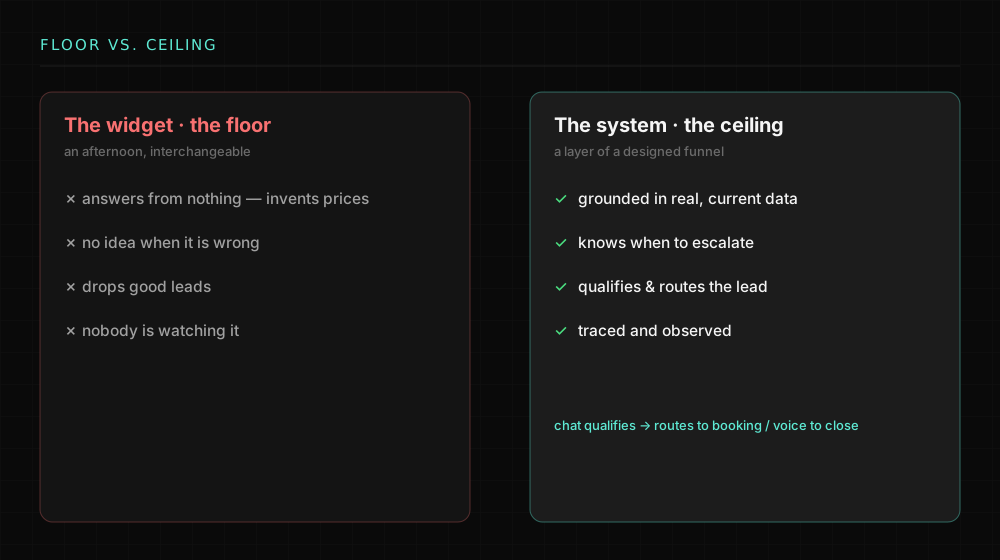
It answers from nothing. A chat agent with no grounded source of truth answers from the model's general knowledge and whatever vibe the prompt sets. So it invents prices, hours, policies, and product details — not maliciously, just confidently, because that is what an ungrounded model does. The fix is retrieval against the real, current business data, with the freshness to know that the price changed and the access control to never surface something the visitor should not see. That is the answerability question before it is an embeddings question.
It has no idea when it is wrong. The floor-level agent has one mode: answer. It does not know the difference between a question it can ground and a question it is guessing on. A system knows when to say "let me connect you to someone" instead of fabricating, and that refusal behavior is a thing you design and evaluate, not a thing you hope for.
It does not know what to do with a good lead. A visitor signals real intent and the floor-level agent... answers the question and ends the conversation. The whole commercial point — qualify, capture, route to a booking — is exactly the part the generic widget skips, because that part requires it to be wired into the rest of the business.
Nobody is watching it. It is on the front page saying things to customers and no one has traced a single conversation, set a quality bar, or caught the regression when the model was swapped. It is unsupervised software talking to your prospects.
The actual move: chat as a layer, not a product
The strongest positioning for a chat agent is to stop selling it as a standalone product. On its own it is a commodity. As one layer of a system, it is leverage.
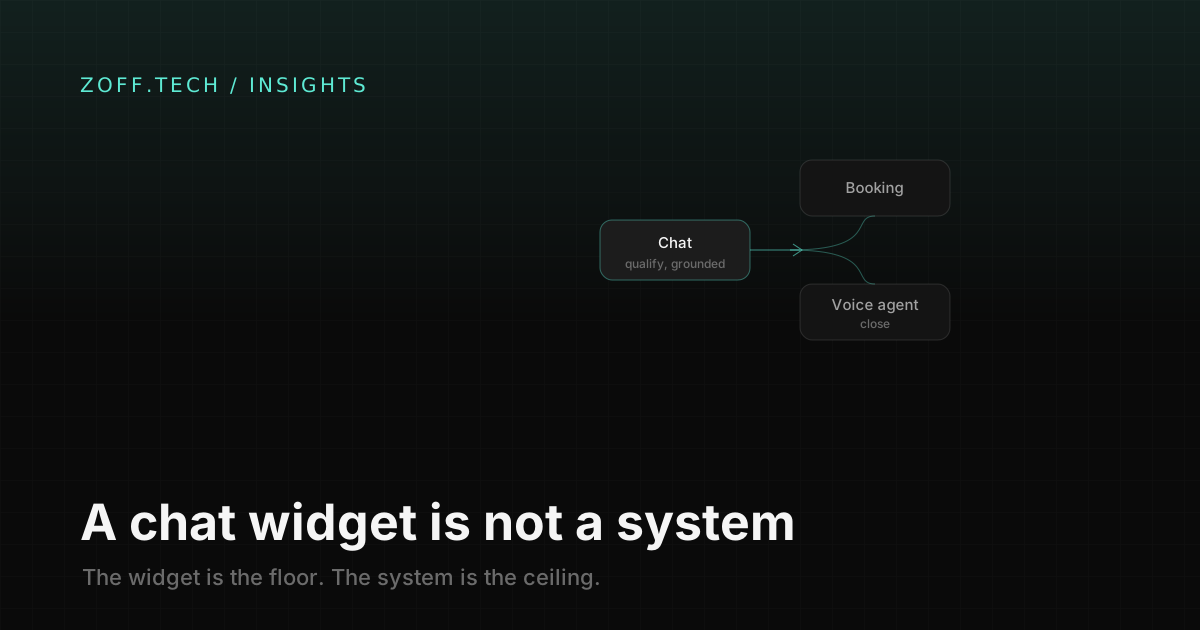
The pattern that holds up: chat handles initial qualification, then routes into the rest of the funnel. The visitor types a question, the agent grounds the answer in real data, recognizes intent, qualifies the lead, and hands off — to a booking flow, or to a voice agent that closes. Sold as a unified system — qualify in chat, book and close in voice, all wired to the real calendar and CRM — it is a different offer than a widget, and a much harder one for the next afternoon-project to copy.
This is the same lesson that shows up everywhere in this work. The model call is the commodity. The system around it — grounding, refusal, routing, observability, the connection to the business's real state — is the product. A chat agent that is only a chat agent competes on price with everyone. A chat agent that is the front door of a designed funnel competes on results.
A chat widget is an afternoon. The system around it — grounding, refusal, routing, the watching — is the part a competitor can't reproduce by dragging the same widget onto their own site. That distance is where the work, and the moat, actually lives.