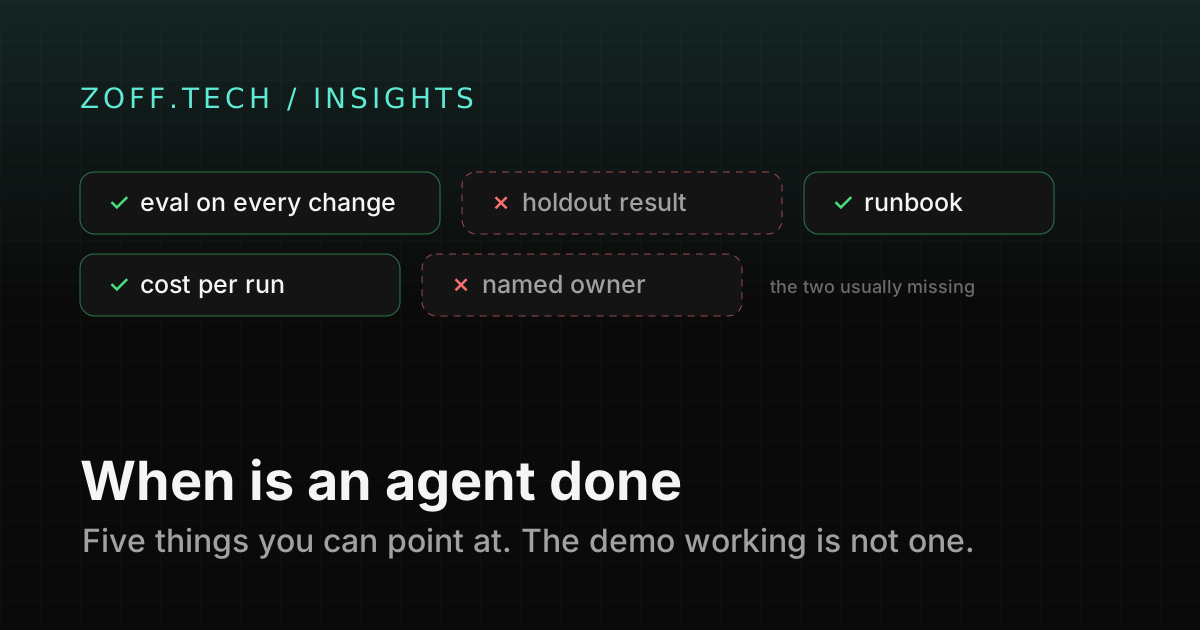
"Done" is the most expensive word in an agent project. Call it too early and the agent lives for months as a demo that someone has to babysit. Call it too late and the budget goes into polish nobody asked for. This essay is the exit test I use for the Build stage of Discover, Design, Build, Scale, and the reason Scale never starts for most pilots is that this test was never written down.
The demo working is not done
The demo works for the people who built it, on the cases they tried, on the day they tried them. That is a necessary condition and a weak one. Production traffic is not demo traffic. Models get updated under you. The person who understood the prompt leaves. "It works" is a statement about the past, and the business needs a statement about next quarter.
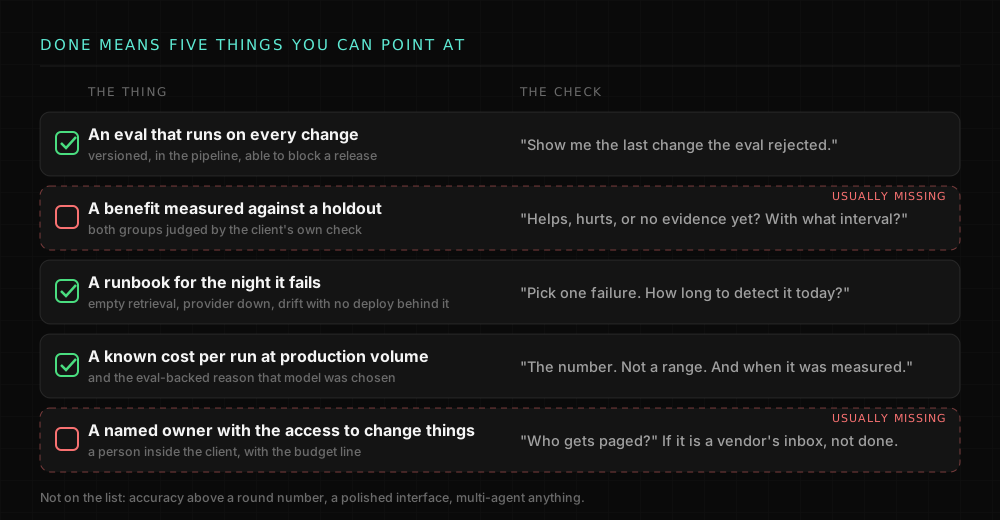
So I define done as five things, each of which is a thing you can point at.
1. An eval that runs on every change
Not a notebook someone ran once. A versioned set of real cases with expected outcomes and a threshold, wired into the pipeline, able to block a release. If a prompt change drops the pass rate, nobody has to notice; the pipeline refuses the merge. An eval harness is a product, and it belongs to the client.
The check: ask to see the last change that the eval rejected. If there has never been one, either the agent is perfect or the eval is not really gating anything.
2. A benefit measured against a holdout
A random share of runs went through the old path, or through the plain agent without the thing being tested. Both groups were judged by the client's own check: tests passed, ticket closed, person approved. The result is a difference with an interval and one of three verdicts: helps, hurts, or no evidence yet.
I hold my own work to this. On our open-source agent memory library, the holdout's verdict on realistic tasks is still "no overall benefit yet", and on one run a wrong lesson did worse than none. I publish that because a measurement that cannot say "no" is not a measurement. A build that cannot show this number is not done; it is deployed. The design is in a holdout for AI pilots.
3. A runbook for the night it fails
Production AI fails in ways ordinary runbooks do not cover: retrieval returns nothing relevant, the model provider degrades, quality drifts with no deploy behind it, a tool starts returning a new error shape. The 3 a.m. runbook names each failure, how you would notice it, and what to do. Done means it exists and the on-call person has read it.
The check: pick one failure from the runbook and ask how long it would take to detect today. If the answer involves a customer complaining, the observability is not there, and that is the subject of what a leader should see about every run.
4. A known cost per run at production volume
Token spend on a multi-step agent compounds. A build that picked its model by preference rather than by the cheapest one that passes the eval, or that ignored cache-aware design, can cost several times what it should, every month, forever. Done means someone can state the cost per run, the projected monthly spend at expected volume, and the eval-backed reason that model was chosen.
The check: ask for the number. Not a range. The number, and the date it was last measured.
5. A named owner with the access to change things
Not a team. A person inside the client who has the access, the budget line and the authority to change a prompt on Tuesday and know by Wednesday whether it helped. Without this, every change becomes a ticket to the vendor, and the agent freezes at whatever state it was in when the engagement ended. Who owns the agent at month six goes into what that role actually does.
The check: ask who gets paged. If the answer is a vendor's email address, the handover did not happen.
What is deliberately not on the list
Accuracy above some round number. The eval's threshold is set by the business during Design, and ninety percent is excellent for one workflow and dangerous for another. A polished interface. The real user from week two decides what interface is needed, and it is usually less than planned. Multi-agent anything. One agent that is done beats three that are not, and the second agent is its own problem.
Why this list is the door to Scale
Each of the five is something the Scale stage consumes. The eval is how you change the agent without breaking it. The holdout is how you justify the second one. The runbook and the owner are how it survives month six. The cost is how it gets a budget line instead of an experiment code. Skip one and Scale does not start late; it does not start.
If you want to run this test on an agent you already have, that is a short exercise, and it is one I do inside a free AI readiness assessment. The answer is usually two of five, and the two missing ones are usually the holdout and the owner.