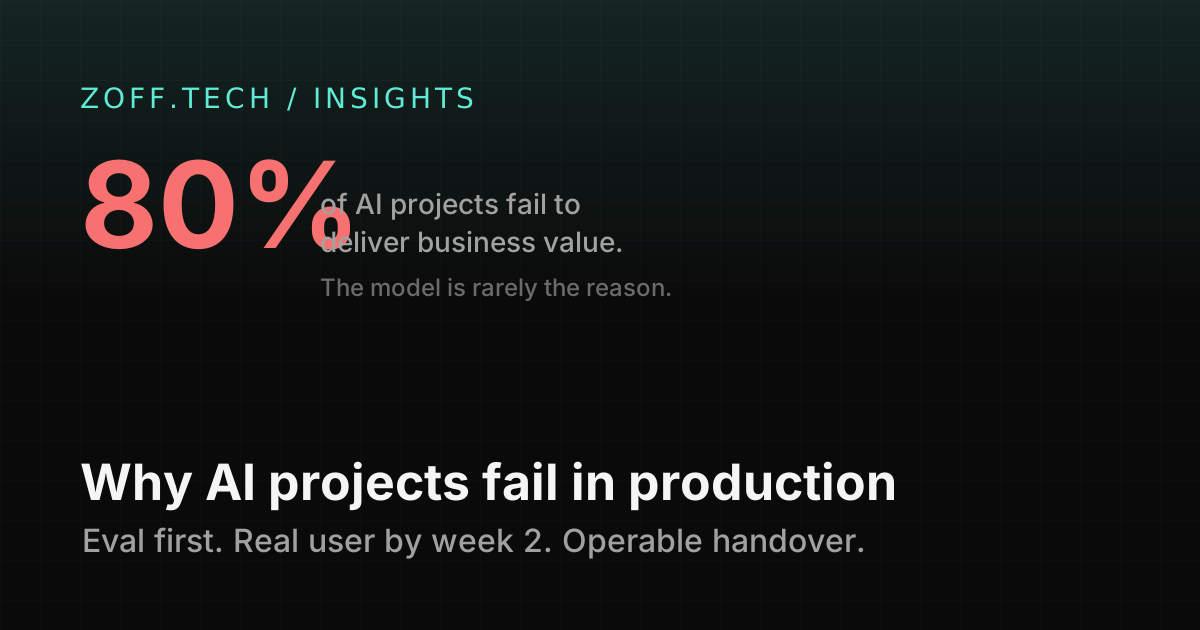
Depending on which study you read, somewhere between 60% and 95% of AI pilots never reach production. RAND puts it at more than 80% failing — twice the rate of IT projects that don't involve AI. And the trend is getting worse: S&P Global's 2025 enterprise survey found the share of companies abandoning most of their AI initiatives jumped from 17% to 42% in a single year, with the average organization scrapping nearly half its proofs-of-concept before production. Underneath the numbers is a quieter cost: by the third failed pilot, the executives stop attending the reviews and the organization decides, implicitly, that "AI doesn't work here."
Here's the part that matters: the model is almost never why it failed. A NTT DATA consultant put it bluntly — "the model is rarely the main problem." The failures are organizational and operational, and they're predictable. Which means they're preventable.
Why they actually die
The recurring causes, none of them about the LLM:
- No measurable objective from day one. The most common root cause. "Let's explore AI" with no number attached produces a demo that nobody can decide is good, so it never ships.
- Data that isn't ready. A Q3 2024 Gartner survey found 63% of organizations don't have — or aren't sure they have — AI-ready data. A demo runs on curated data; production doesn't get that luxury.
- Architecture that was never built to survive past the presentation. PoCs are scoped to show capability, not to handle real auth, integration, compliance, and the long weird tail. The demo clears a sandbox; it can't clear production.
- It was never operational. If the team is manually preparing prompts and curating data during the pilot, the system isn't operable — it's a person doing the work with an AI in the loop. That doesn't survive handover.
Every one of these is a decision made (or skipped) in the first weeks, when it's still cheap to change. They become fatal in month six, when it isn't.
The three rules that keep ours alive
We didn't invent the failure modes — we built the practice around avoiding them.
- The eval before the prompt. Every build starts with an evaluation dataset and explicit thresholds — the measurable objective the failures lack. If we can't write a defensible eval in the first two weeks, we kill the engagement and refund the discovery fee. No green eval, no merge. That single rule removes the "nobody can decide if it's good" death.
- A real user in the system by week 2. A PoC with no path to production hides the hard decisions. We put a real user on it early, so the architecture calls get made against a real transcript — while they're still cheap — instead of being discovered in production.
- Operable handover, not a repo. We hand over the runbook your on-call opens at 3 a.m., the dashboards, and the keys — under your name. The test isn't "does it demo," it's "can your team operate it without us." A system that can't be operated is a pilot wearing a launch date.
The honest framing
The reason 80% fail is not that AI is hard to build — it's that most teams build the demo and skip the operating system around it. The model is the 10%. The eval, the data discipline, the runbook, the human checkpoints, the observability — the boring 90% — is what decides whether your project is in the 20% that lives.
If you've already had a pilot stall, you know this feeling and you're rightly skeptical of the next pitch. Good. Ask the next firm you hire for the eval, the week-2 user, and the runbook. If they can't produce all three, you're looking at pilot number four.
That's the conversation we want to have. Bring us the problem, the owner, the budget, and the date.